Morocco. The mysterious land on the edge of the Sahara. Land of wild mountain scenery, uninhabited desert
and palm fringed oases. Land of vibrant, ancient cities but also a land that is trying to
prepare itself for the 21st century. A country that is ready to be explored. We want to
cycle the coming two weeks from Marrakech across the Atlas into the Sahara. The idea was
born two months ago. Willem, Marco and I were able to organize two weeks together and we were
able to arrange flight tickets to Casablanca as well. So here we are at the Mohammed V
airport of Casablanca. We saddle up our bikes and we walk with our loaded bicycles
out of the ariival hall of the airport and step into the sultry Moroccan night.
After camping in the bushes along the highway, we wake up and cycle to the small
town of Berrechid. We arrange train tickets to Marrakech on the deserted railway station
of Berrechid. We have to wait a few hours, hours that we spend in exploring the town. The town
does not have any highlights and maybe is all the more special because of this. We see
how life takes its daily routine in a town like a thousand others. Children are playing football,
people are selling and buying vegetables in the small grocery stores. In improvised stalls
people are selling delicious, selfmade tajines. Nothing special but half a world away from
our own society that we have left less than a day ago. After the happily spent waiting hours
we take the afternoon train to Marrakech, the place where we will start our bike journey.
Marrakech, evening time. A young man leads us to a hotel. He is smooth and gentle and is smiling all the time,
says he likes the 'tourist people'. This is the way people try to make some Dirham,
the local currency. After leaving our luggage, it is time to explore the city of Marrakech.
Marrakech is a lively, energetic city. The souk is immense. It is easy to get lost in
the small, busy streets and back alleys and so it happens. We must have passed all the little
shops and market stands before we finally find a way out.
Day 1: Marrakech - Taddert 85 km
Cycling out of Marrakech is a special experience. The scenery is brilliant with its city
walls, its abundance of palm trees and the majestic white peaks of the Atlas in the
distance. And not at least because of its pleasingly chaotic traffic sceneries. Old trucks,
even older automobiles and horse carriages flow through the alleys smoothly
without getting stuck in large traffic jams.
Because we have cycled a wrong way, we are now cycling northward along the east
boundary of the city. We ride through new slums. The atmosphere is quite nice
despite the poverty. I do not see any underfed people, nobody is making
problems that three strangers are crossing their neighborhoods.
After leaving Marrakech, we are back on the right track soon. Thirty kilometres we ride
through the plains before we reach the foot of the Atlas mountains. We are riding on the
road to Ouarzazate, the biggest town southward of the Atlas.
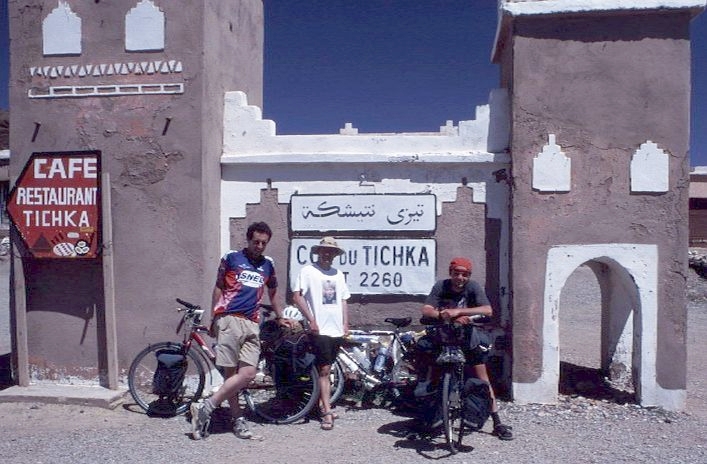
The road crosses the Atlas at the Tizi 'n Tichka, a pass of 2.260 m elevation.
The first village on the way up is drenched in poverty. Little boys come to us,
begging for 'stylos'. They want to have a pen. We ride on, tens of young boys
shouting and screaming for stylos running like crazy behind us. When they cannot
follow any more, they try to throw stones to us. Welcome in Morocco!
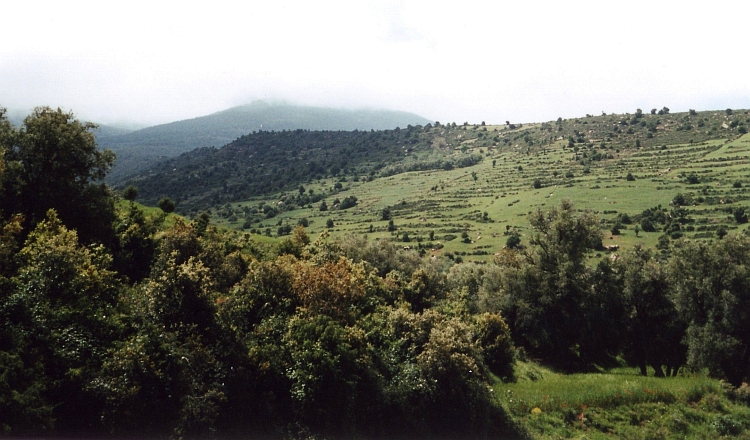
The road to the Tizi'n Tichka is extremely rich in variation. Now we pass a dry stretch,
full of blossoming cactuses, then we ride through a dense forest to leave for Tuscany alike
pastures. After a first pass of 1.410 m elevation, we descend two hundred meters.
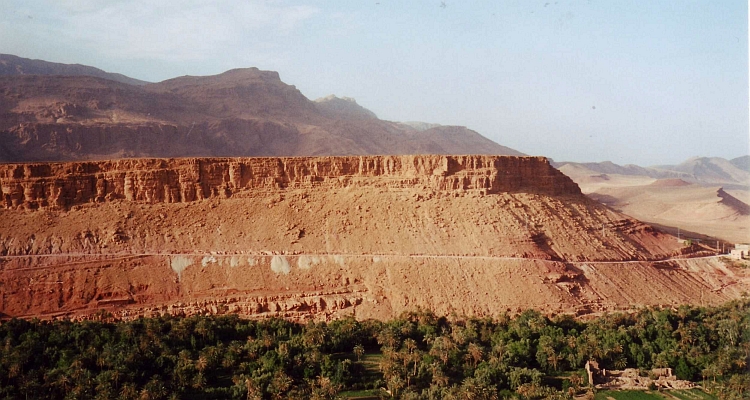
The landscape is becoming really mountainous now. The rocks have strangely beautiful colours
in red, purple and turquoise green. As we reach a small valley, we try to find a place
to sleep. We are lucky that a farmer asks us to sleep on his land. Right before his
house we can pitch our tents. When we are ready and begin to cook our meals, we are surprised
by the hospitality of the people. The man brings us all kinds of delicious meals.
More and more highlights of the Moroccan cuisine follow and are brought by the man or by the kids.
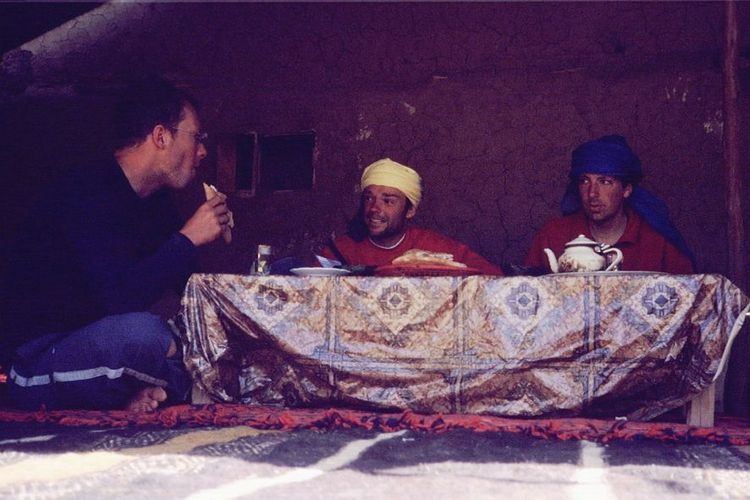
When we are finally ready, we get traditional mint tea. And of course a dessert: sweet
little cakes, all as good as one can possibly hope for.
Day 2: Taddert - Telouet 65 km
After thanking our hosts and giving the kids a football, we leave the picturesque
place. The road leads further up along the valley. The valley is still green. There
are still pastures along the river. The last 15 kilometres are somewhat steeper. It
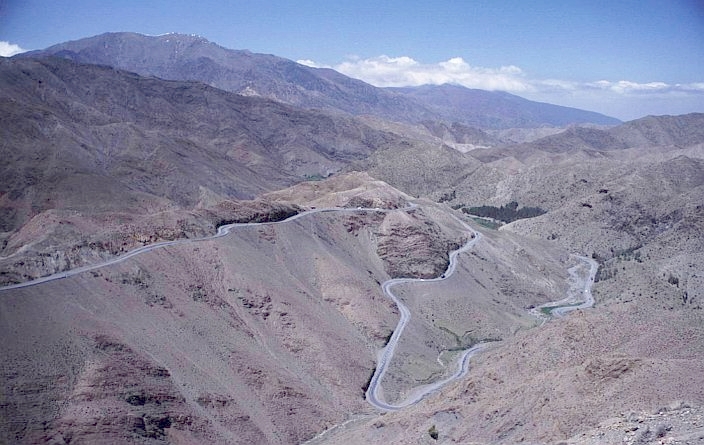
looks like we are beginning to enter a desertlike zone. Over desolate treeless
slopes the road winds upward, untill we reach the pass. From here it is only downhill
over bright and shiny asphalt to reach Ouarzazate. But not for us. We decide to take the hard way.
A dust trail also leads down to Ouarzazate. That will surely lead to more contact with the
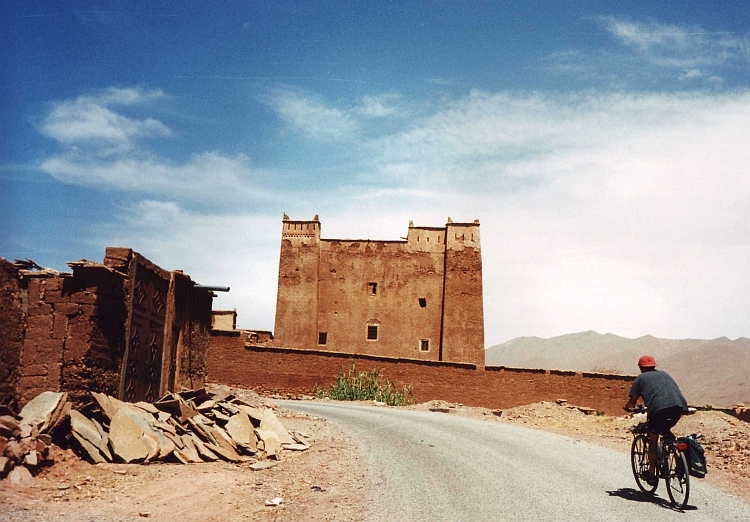
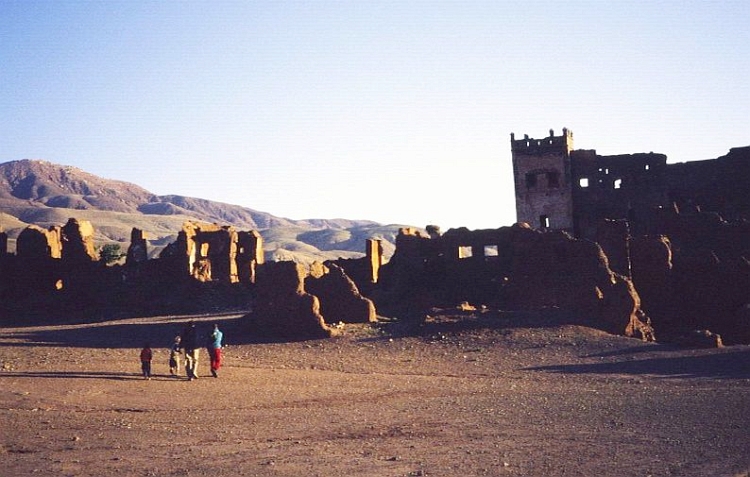
local people. There are some casbahs too along the way. The old fortresses are to be
found in telouet and Aït Benhaddou.
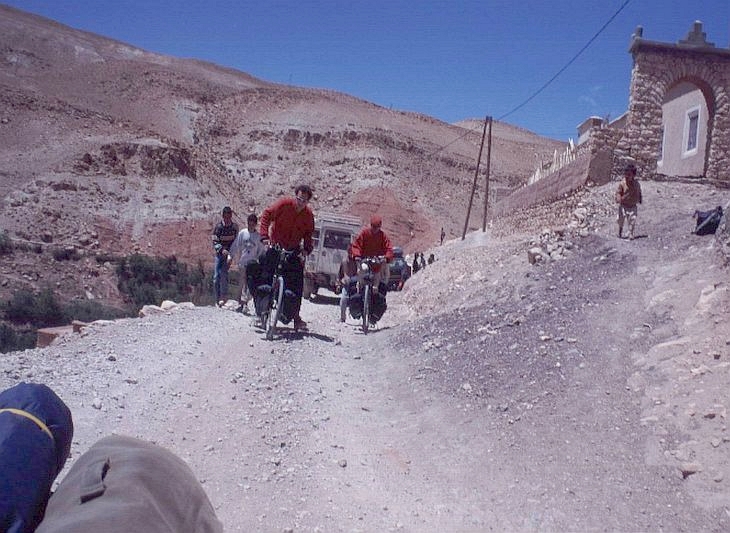
We hoped to make contact with the local people and that is what we have got. We have
entered true stylo land here. The kids are everywhere and always good for making a lot
of noise about stylos and how much they need a stylo on their schools. We do not have a
pen but we would not have given one if we had. Giving what they want is the one thing to
spoil the kids even further. More than a stylo the kids need proper education and some
decent values to base their further life upon.
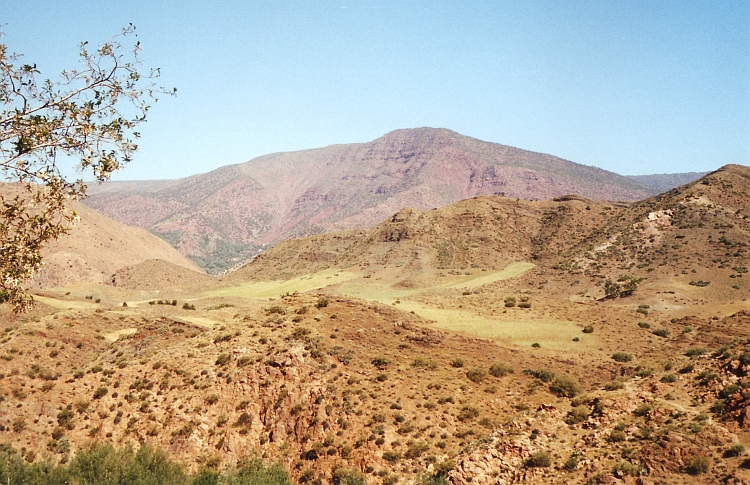
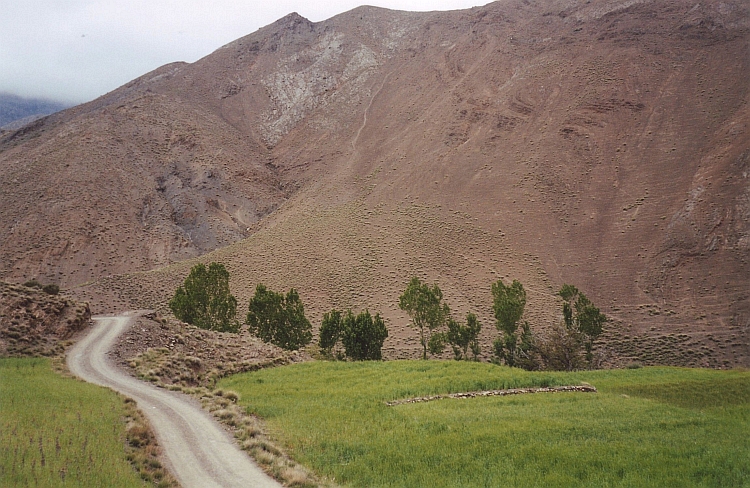
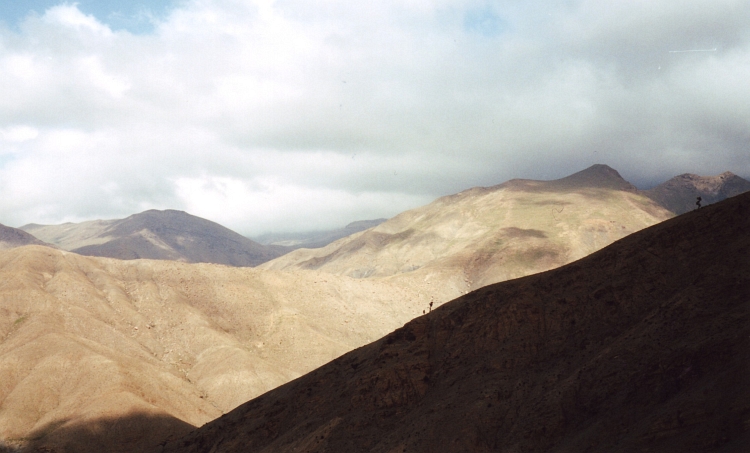
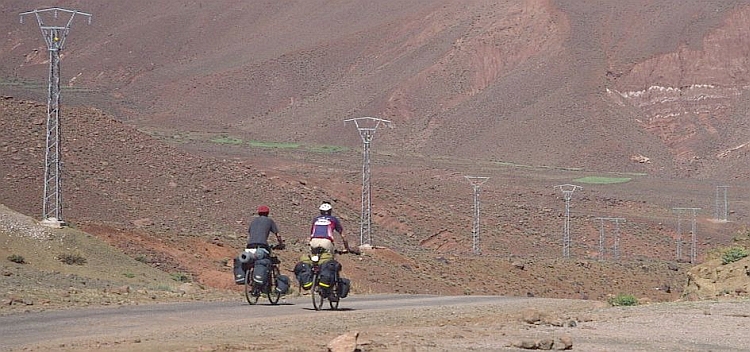
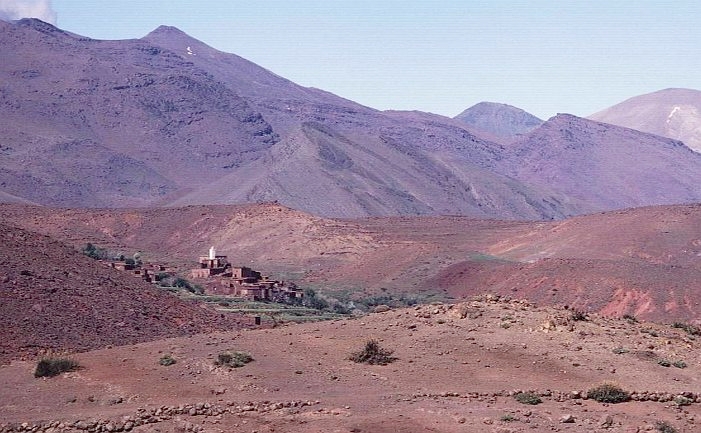
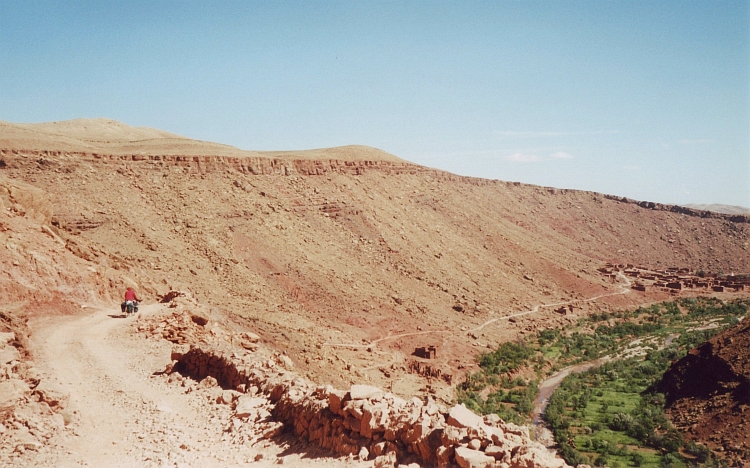
The road to Telouet is one of stark contrasts. The landscape is fabulous. The
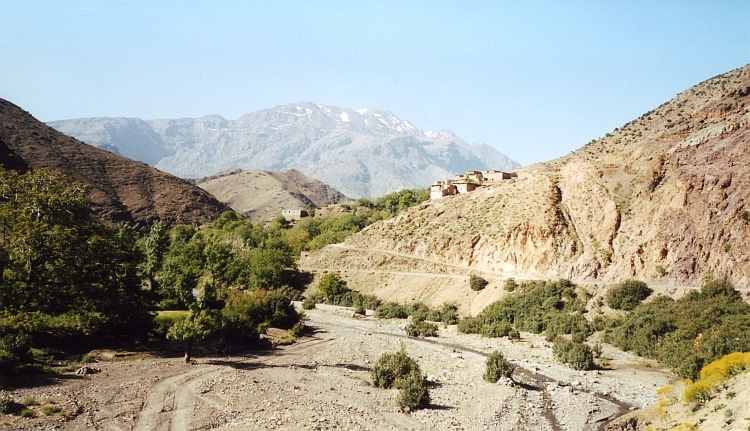
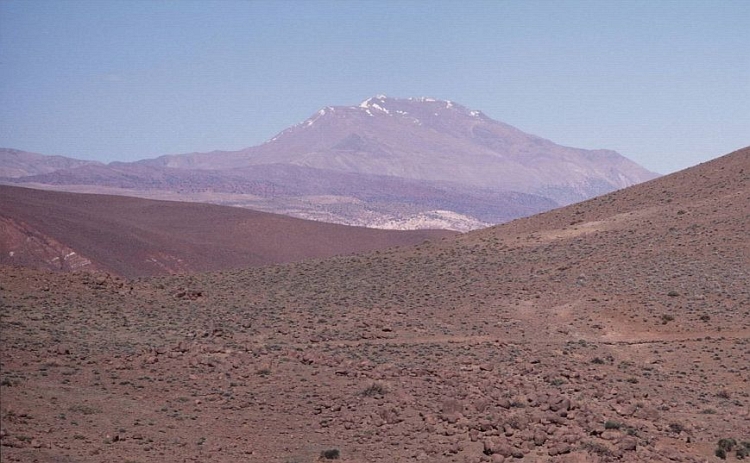
Southside of the Atlas has wide valleys with only few vegetation. High peaks of
4.000 m elevation still have a bit of snow around their peaks. Rocks have all
possible colours, green, yellow, pink, purple. The variation never seems to come
to an end. The road is quite bad. Travelling is slow when climbing on these cobble
roads. It can be a severe hassle to be this slow, especially when hords of kids
are running behind you for a stylo.
We reach Telouet safe and sound. We find a hotel, where we sleep on the roof where
it is not as bloody hot as in a hotel room.
Day 3: Telouet - Aït Benhaddou 70 km
It is another beautiful day with clear blue skies. The dirt trail lies parallel to the Atlas
mountain range, which means that we go up and down. I had not expected that the landscape
would have been this beautiful. Sometimes we have dazzling views over the Atlas.
At other times we cycle in narrow valleys. The road again leads us through
strangely beautiful multi-coloured landscapes without much vegetation. For two hours we
enjoy the quite road. Here are no villages which means that we do not have to bother
about the kids.
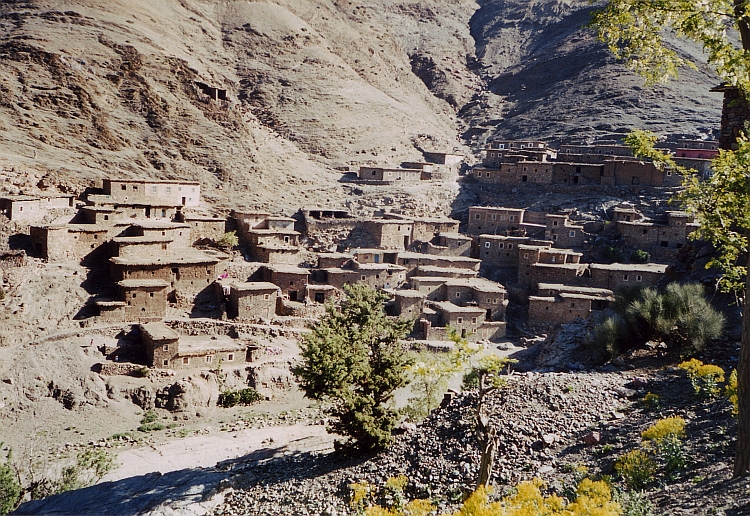
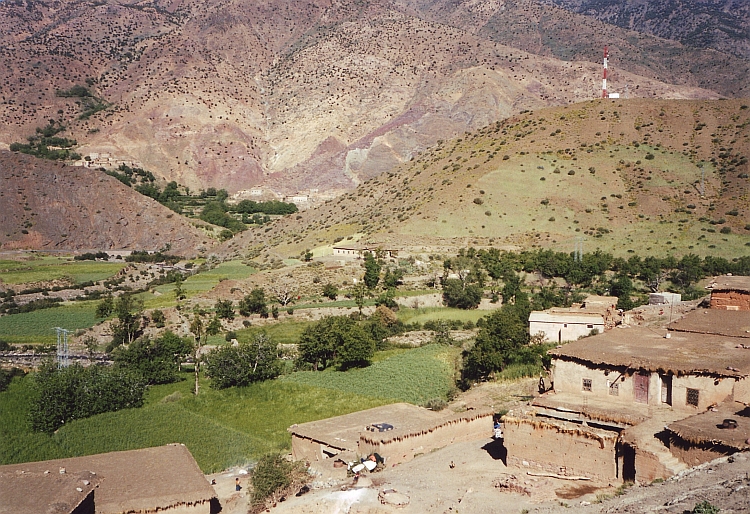
All of this changes dramatically as we reach the river Valley of the Assif Oumila. Along
the valley lies a string of villages. A few families make a living in the villages. The few
families have produced a whole lot of kids and a whole lot of kids can make an awful
lot of noise about a stylo. The road does not get any better too. The road is clayey
and very irregular. Bumping and stumping we go down. I am getting sick. I do
not know whether it is the food or the shaking and stirring on the road, but this
is surely no good. There is no alternative but to go on. In these hostile environment
we do not like to stay for the night, nor for the day.
Things go from bad to worse as Marco's front pannier comes between his spokes. This
will surely have been caused by the bumping on this bad road. Now we are not moving,
the kids try begging. In fact they are not begging but seeking for an opportunity to
steal something. Willem has to chase one kid away who was able to grab a pump. After an
hour of repair and trying to keep kids away from our bags and stuff, we can go on.
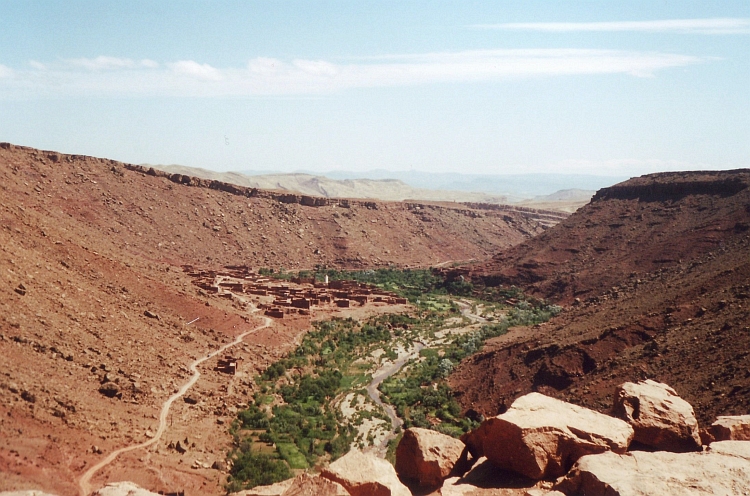
The landscape is beautiful with the green river valley below us and the barren
slopes above. The environment is however to hostile to really enjoy this and so
are the bacteria in my stomach.
A little further Marco has a flat tyre. This time again we are surrounded by boys who try to steal
things, but this time they are succesful. I find out way too late. After descending half an hour
I see that some film is taken away and a toilet role. I can easlily live with the latter
but the fact that I have lost some pictures of the beautiful landscapes of yesterday and today
make me feel as bad mentally as I already felt physically.
Things are not going well today. I am feeling really horrible now. In the vicinity of
Aït Benhaddou we finally find a hotel where I can have some rest. The first thing I do is to run to
the toilet where I throw everything out. I feel I am having a fever. Although it is plus
thirty degrees I feel like I am freezing. Even under huge amounts of blankets I feel as cold as ice.
Day 4: Aït Benhaddou - Ouarzazate - Agdz 90 km
As I wake up in the middle of the night I am bathing in sweat but feeling a whole lot of better
than a few hours ago. I fall into a deep sleep again. When I wake up, Marco and Willem
had eaten their breakfast already in the knowledge that I would be too sick to have breakfast,
nor to travel any further. I am feeling surprisingly fine though. Carefully I try to
eat a bit. Everything seems fine. I decide that it is possible for me to cycle today.
Within an hour we reach Ouarzazate. Not the most beautiful city of Morocco but good enough
for a break with mint tea. I feel that my condition is improving by the minute. Marco's
condition however is deteriorating.
Despite the shaky condition of two of the three participants we go on. Southward
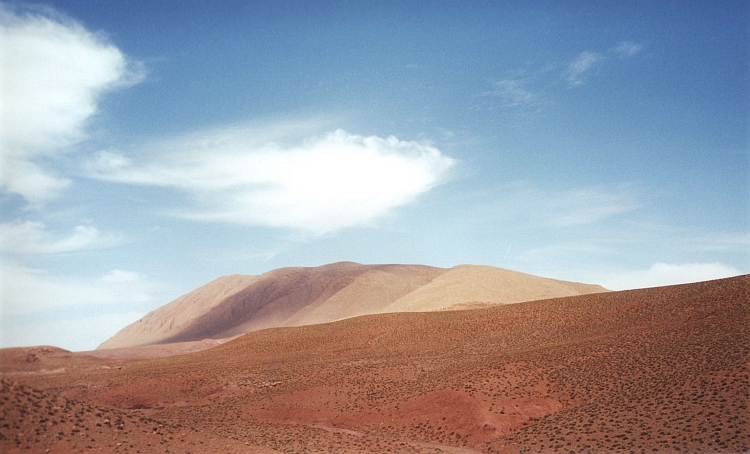
of Ouarzazate we enter true desert landscape for the first time. We have to
acknowlege Frank van Rijn's statement that there are a lot of stones in Morocco.
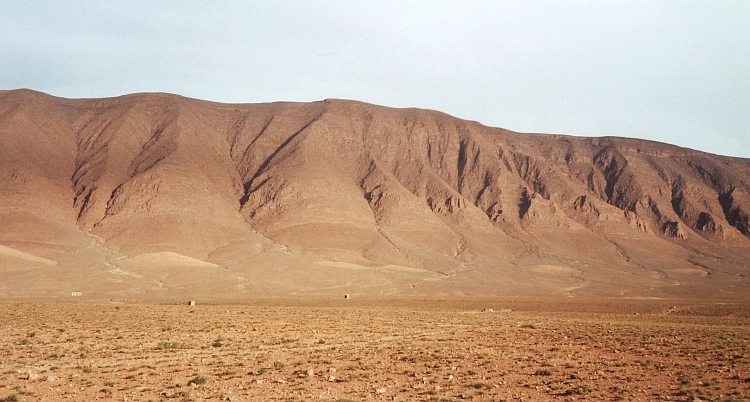
The desert landscape is predominantly brownish. Because the desert plains are
replaced frequently by hill ranges and even small mountain ranges, cycling never
becomes dull. At the end of the day we have to cross a comparatively high range,
which causes some difficulties for Marco but he is doing a wonderful job. Now it is only
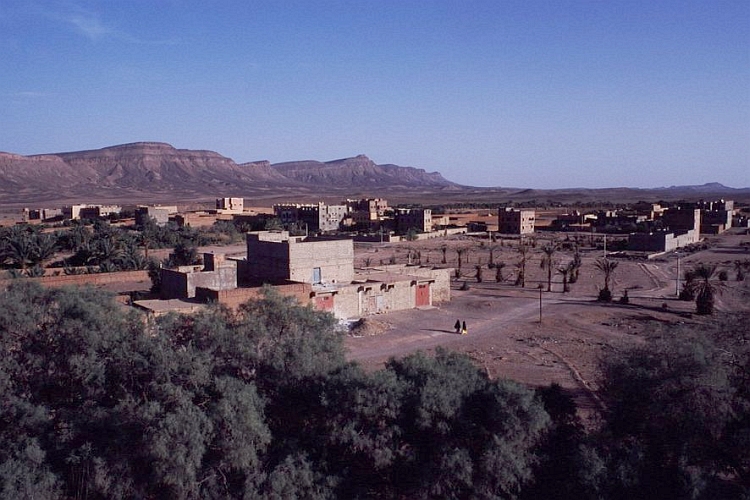
downward to the Drâa Valley along spectacular gorges scenery. The fading sunrays
shroud the mountains and the plains in a mysterious desert atmosphere as we reach
the scenic town of Agdz. There is a campsite just out of town. While we pitch our tents,
the camping organisation arranges delicious couscous with one of Morocco's many great
tajine variations.
Day 5: Agdz - Zagora 90 km
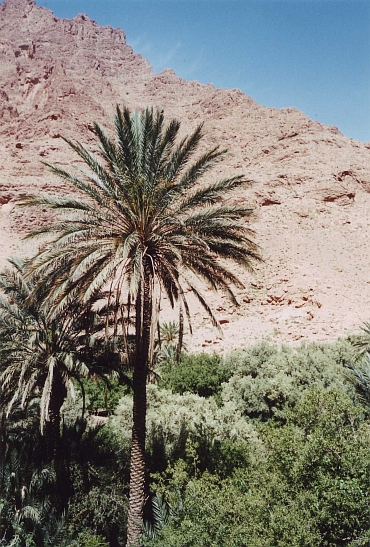
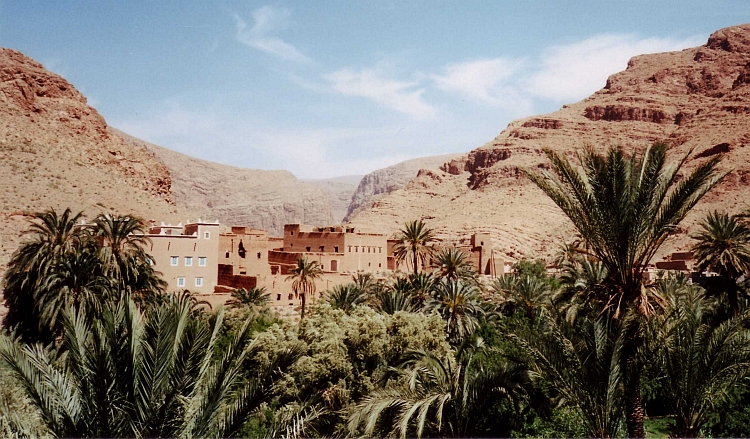
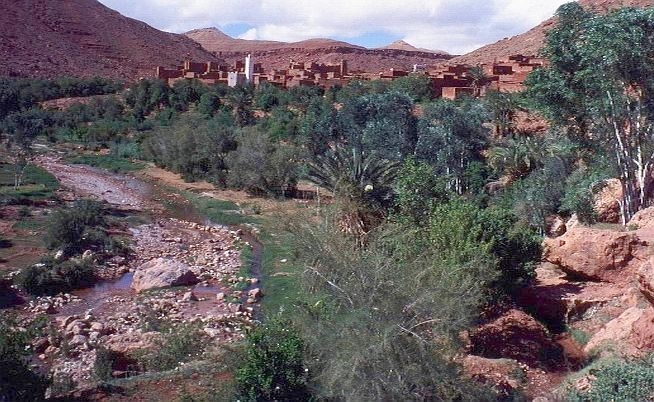
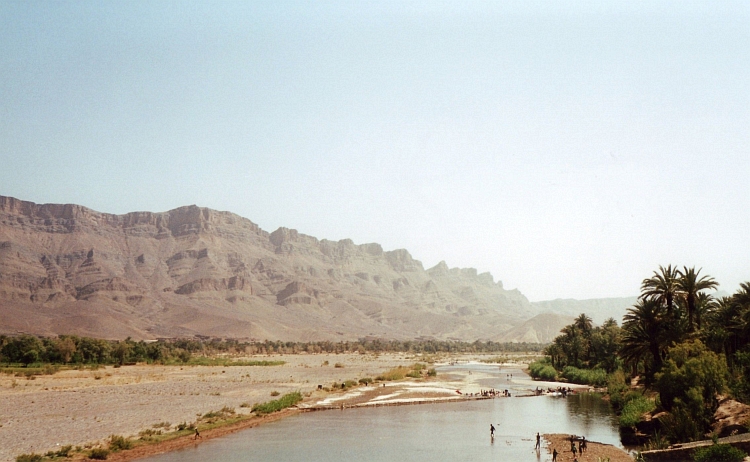
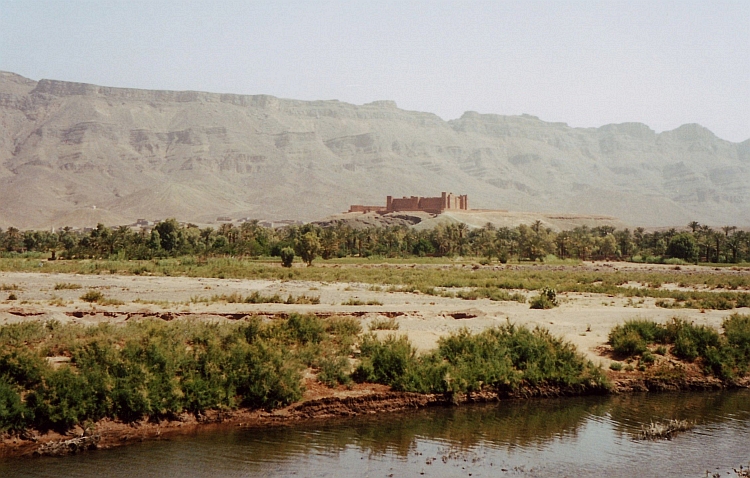
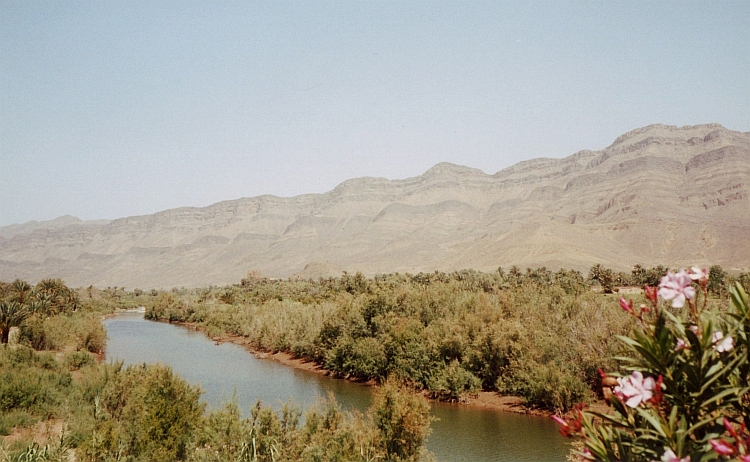
The Drâa Valley is a long chain oasis and is one of the tourist attractors
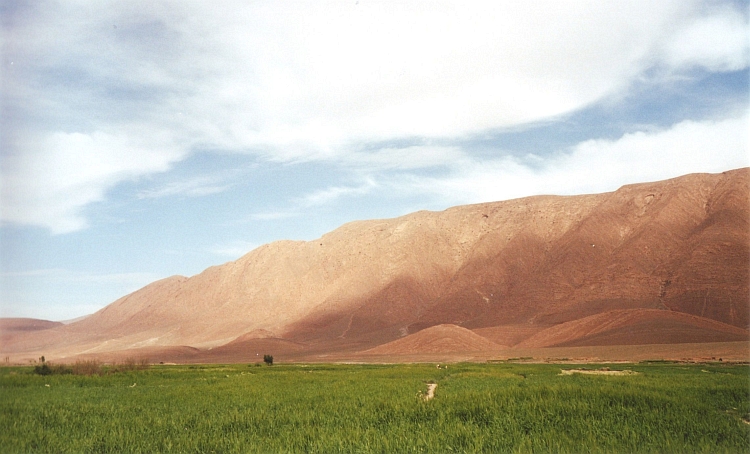
of Morocco. The fertile green valley contrasts deep with the barren mountain
chains that parallel the river. There are palm trees everywhere in the valley. Lots of
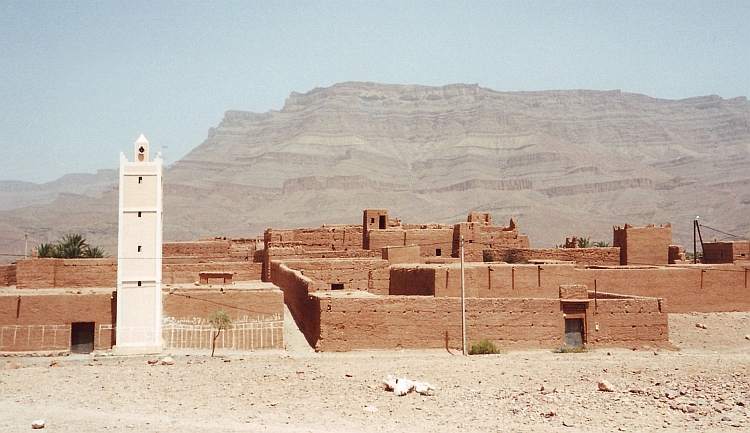
villages and towns lie along the river. Every town and village has at least one casbah.
They are usually in a deplorable state.
It is easy cycling on the flat, paved road. There is more traffic than we are used to.
I am not too inspired, I dislike flat roads but Marco is having a great time. He has
recovered as fast as I had and he likes flat roads and frontwinds.
The Drâa Valley is one of only two rivers that flow southward from the Atlas into
the desert. Both rivers do not survive untill the Atlantic Ocean. In normal circumstances
the river leaks too much water. Only after extreme rainfalls, the river reaches the ocean.
These rainfalls are extremely dangerous. In deserts more people die because of
drowning than because of thirst. It is always wise to put your tent on a high place.
After a hot and dusty day we reach Zagora, the last outpost before a nothingness
that lasts for hundreds of kilometres untill the Sahel region. Zagora is a modern,
booming town. Everywhere modern high buildings are being built, which gives the town
a far less mysterious feel than its name could suggest. We find a campsite just
out of town.
Day 6: Zagora - in the middle of nowhere 55 km
On a terrace of Zagora we are having breakfast. Nipping from our traditional mint
tea we ask ourselves what to do next. We could proceed along the Drâa or return along
the river but both options have the problem of having to do large streches for a second time.
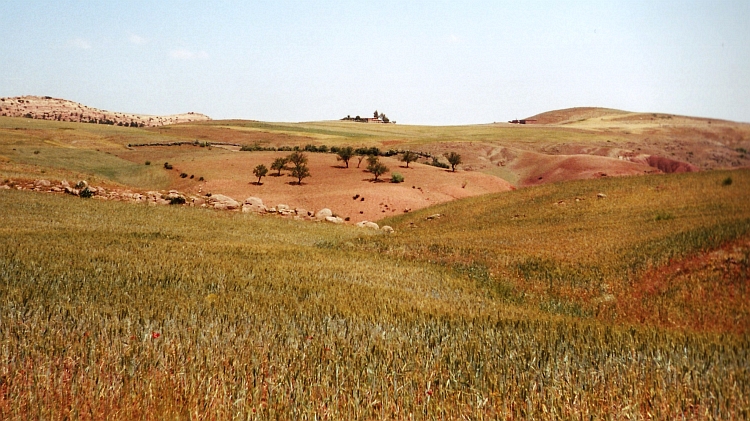
There is a third option. A desert track leads to Tazzarine. In 90 kilometres there
will be no villages. This means that we have to carry a lot of water with us. Further
it is important not to get lost.
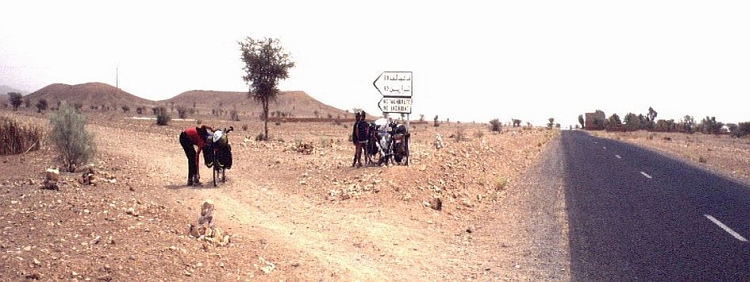
We decide to try the Tazzarine option. We cycle southward 10 kilometres untill we
come to the crossroads where our trail leaves the main road. It is immediately
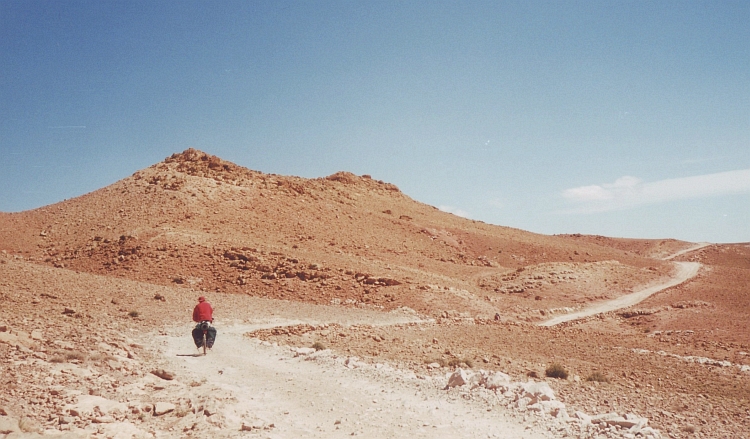
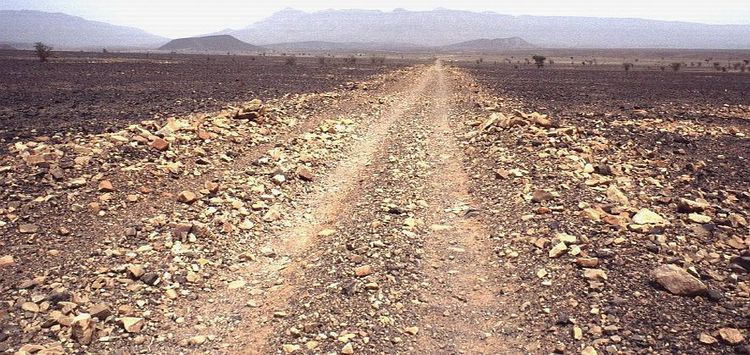
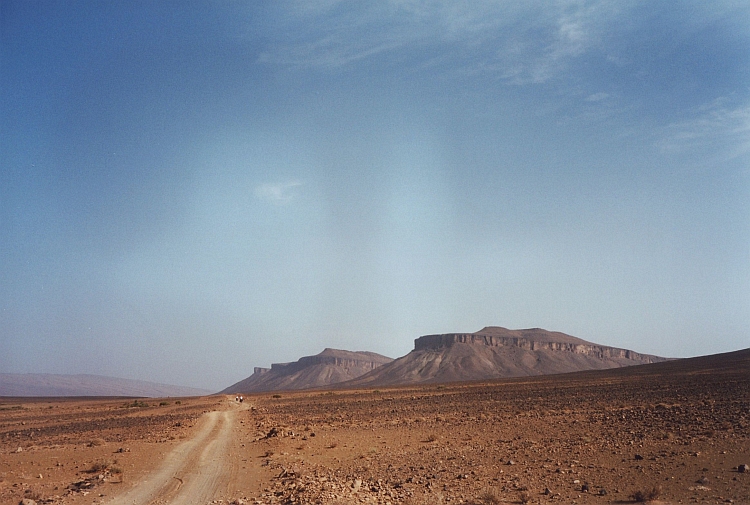
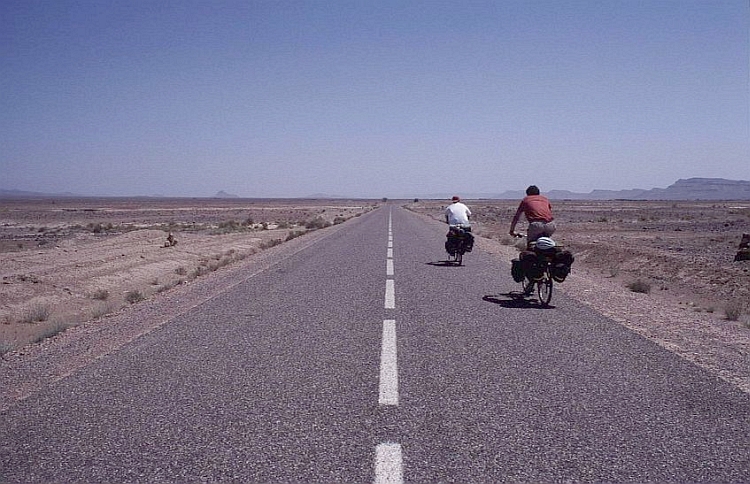
clear that this will be a very difficult journey. This is not a road. We have to cycle
right over the cobbles and stones of the desert. Because of the discussions about
what to do it is already 12 o'clock; the temperature has already reached 35 degrees
or more.
After a short discussion we decide to give it a try. We all have 9 liters of water. That
should be enough for two days of cycling. This is 1 liter for 10 kilometres of
cycling. That has got to be enough. We expect that we will not reach Tazzarine today.
It is only 90 kilometres to Tazzarine but if the road does not improve along the way,
we will surely need two days.
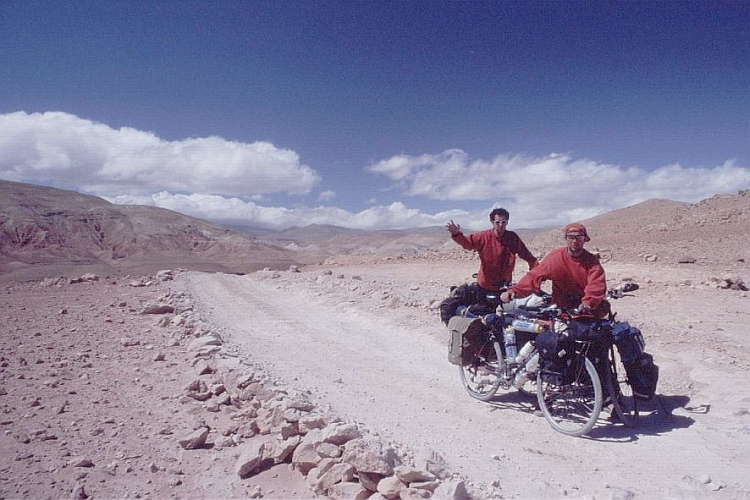
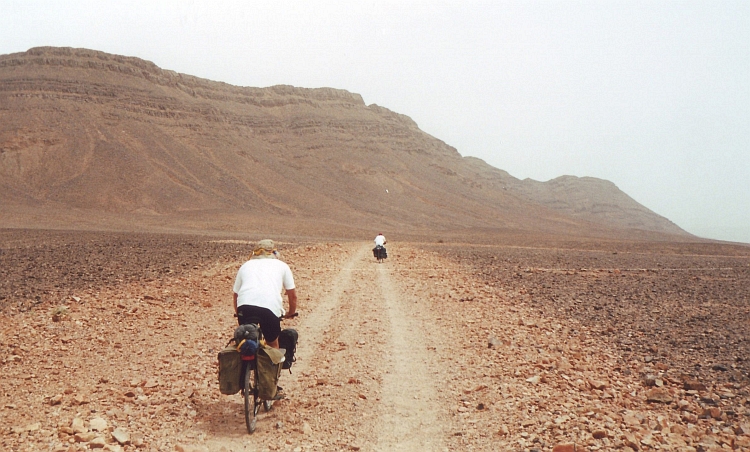
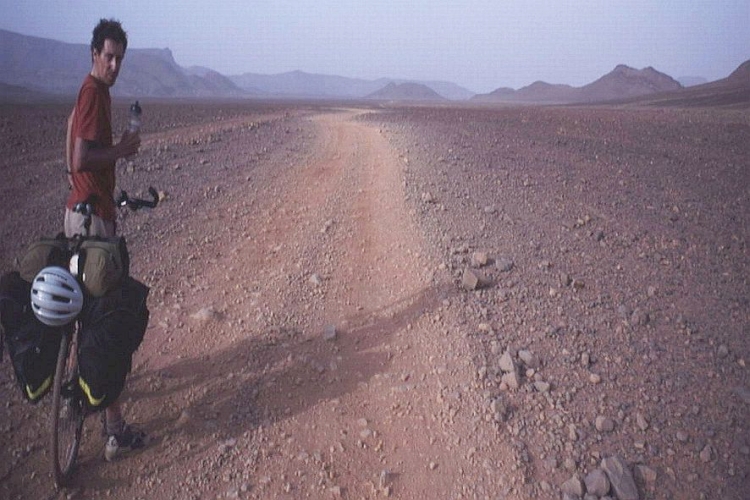
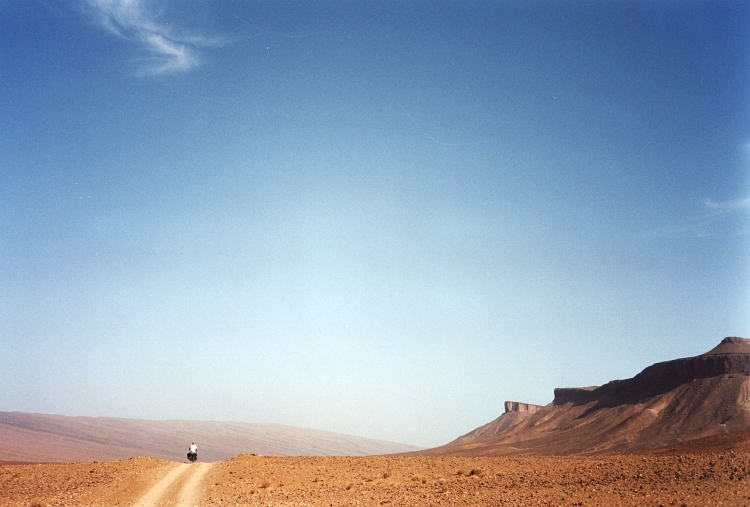
Cycling in the desert is far more difficult than we had expected. The stones are so big that
all our energy gets lost in bumping and stumping instead of forward velocity. We reach
velocities of sometimes less than five kilometre per hour and even this costs huge
amounts of energy. After a kilometre we are drenched in sweat. The hazy desert sun shines
mercilessly on the land. We are losing liters of water. After ten kilometre I have drunk
already two and a half liter, far more than we may spend. We should spend no more than a liter
per ten kilometre. We ride along a hill ridge. Very slowly we proceed through
the nothingness that surrounds us. It takes ever more effort to just go on. I am
having doubts whether we should continue any further. We have not seen a living
soul since we have left the main road fifteen kilometres back. I ask Marco and Willem how
much water they have in storage. Together we have drunk more than half of our
original supplies after 15 kilometres with 75 kilometres to go.
We decide to go on. We surely need to find water though. After a few kilometres
I see a line of dust travelling across the road a few kilometres ahead of us. Is this
a fata morgana? It is not. It is a convoy of trucks. We are lucky; we
can ask for additional water. A few hundred meters before we meet the convoy, I
see the first cars take a different direction. A light panic is coming up. I cannot
accept the idea of missing our saviour by a hair. With all the force that is still in me
I ride towards the trucks. I am just in time for the last truck to see me. The truck
waits for me at the crossroads. I find out the chauffeur is Dutch. In Dutch I explain
our situation. A few beggars reach the place too (where the h### did they come from???)
The truck driver has got sufficient amounts of water and gives away enough for us and the beggars.
Instead of three liters for the last seventy kilometre we now have twelve liters each. The
other trucks have gathered on the crossroads too. It is a pleasant meeting of
likeminded souls. The Dutch truck drivers are also lucky. They were on their way
to Zagora. Without meeting us, they would have taken the wrong direction. If we
would not have met the convoy, we surely had to return the difficult road back to Zagora.
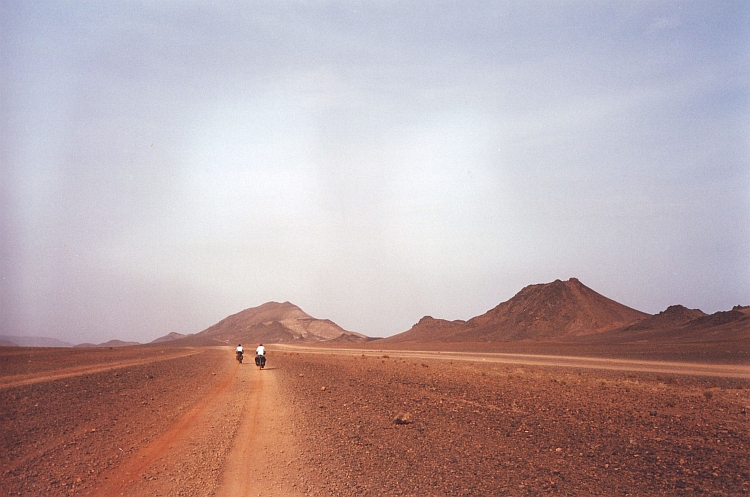
After the meeting, the road starts to ascend slowly to a pass. We are relieved that
we have enough water for the coming hours, but the heat is still making life
extremely difficult. And so does the road which is not much more than a camel track.
Now the road is climbing, we sometimes reach velocities below 4 kilometre per hour.
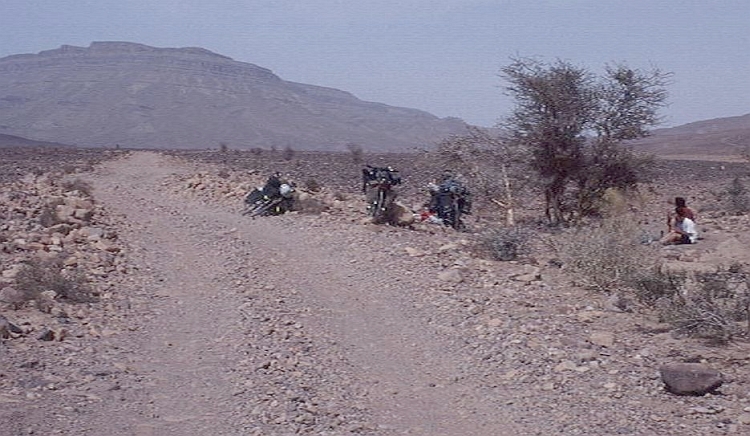
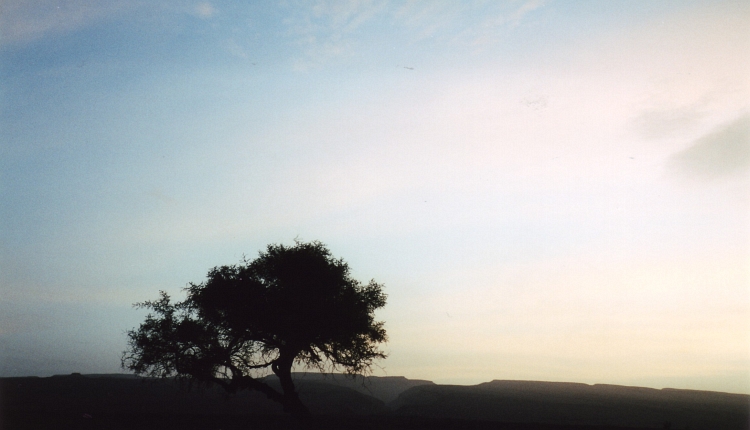
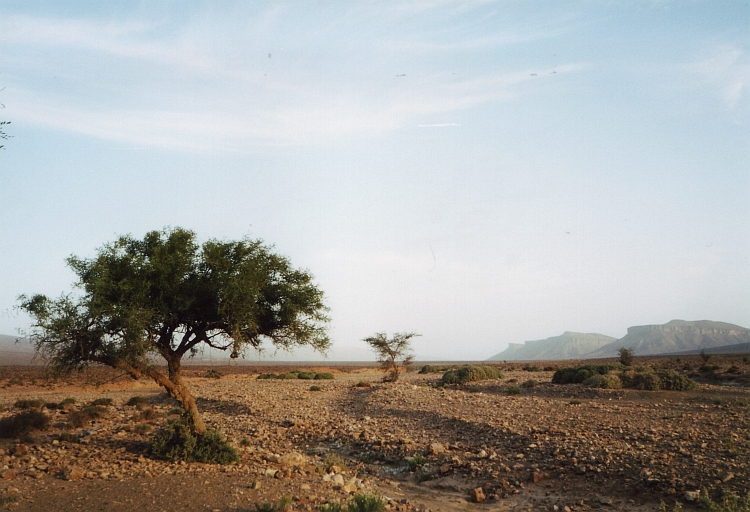
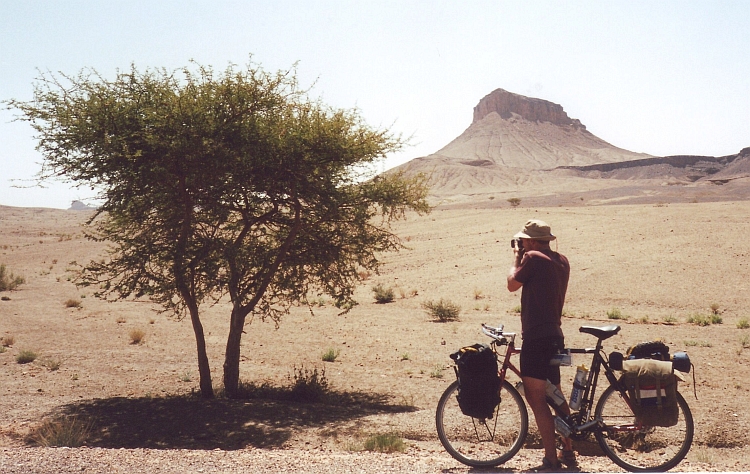
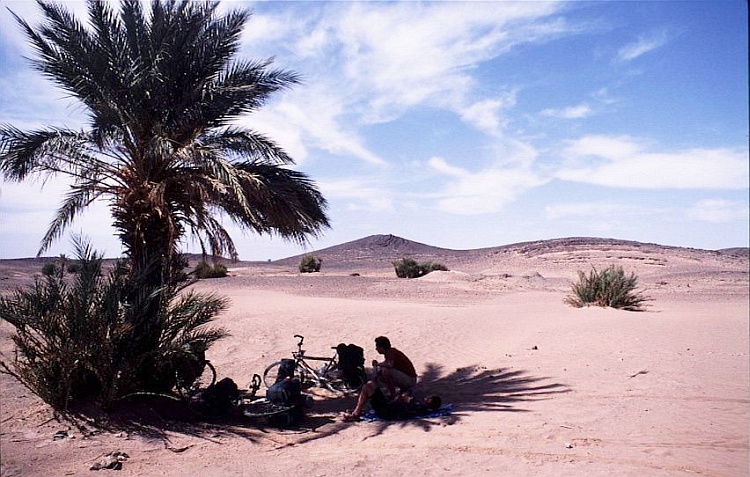
Because we are dead tired, we need to rest under the only tree in the wide surroundings.
The tree produces no substantial shadow at all but it is a tiny bit better than nothing
at all. We have to wait untill it is less hot. In the five kilometres since the gathering
I have drunk already two liters of water. We can best proceed in the colder hours.
For a long time we sit, eat a bit and drink a lot, each in his own thoughts.
After a long time and a few existential experiences we leave the tree. The sun is slowly descending
towards the horizon. We have two hours of daylight to go as far as we possibly can.
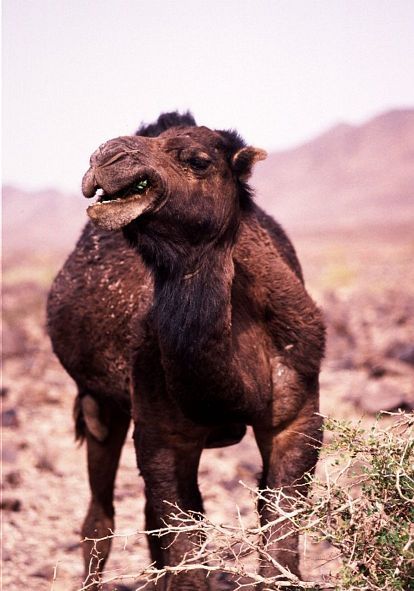
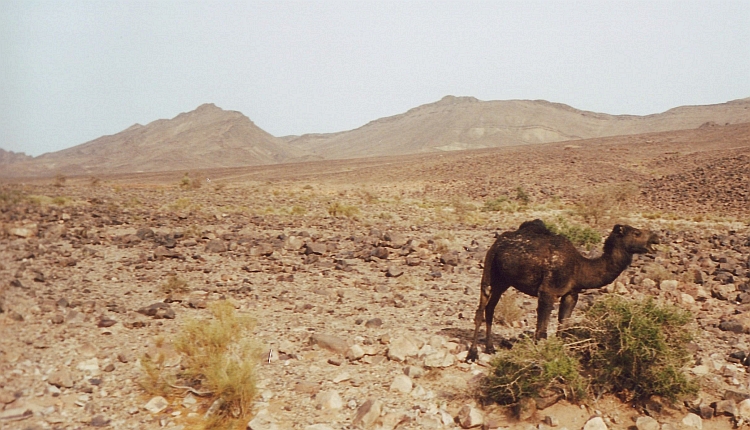
It takes half an hour to reach the pass. After the huge effort we are surprised
by finding a lonely dromo at the top. The dromedaris must have an owner; even in
these remote desert areas must be human existence. Probably there are nomads in
the vicinity. We do not see them.
Completely devastated. Nothing less is the state I am in after many hours of cycling
on this road in this heat. We have had the worst now. After the pass we come into a wide desert valley that
gradually goes down. Less than 1 % gradient downward means that our top velocities
increase to more than ten kilometre per hour. The temperature starts to drop. Life
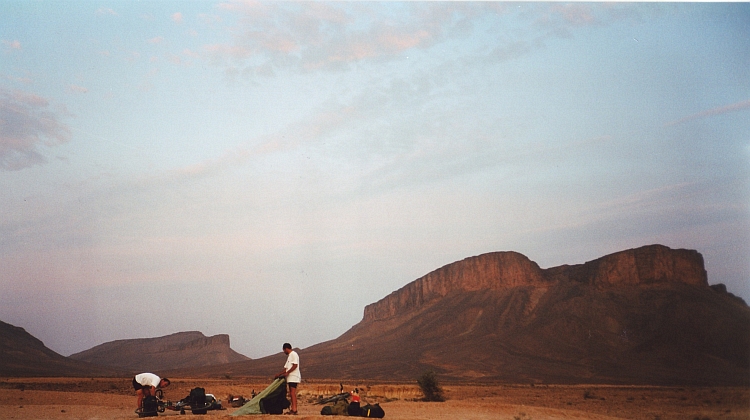
is beginning to get less complicated. The last hour we proceed fairly well. We pitch
our tent in the beautiful valley. Our reward is some ultra dry couscous but it is good enough
for us.
Day 7: Campsite - Tazzarine 45 km
We stand up early in the morning to travel as much as possible during the 'cold'
hours of the day. Strange enough, when we wake up, there are very poor beggars
before our tent, a young girl with a baby. The girl is walking barefooted. Her clothes
seem age old. We give the couscous to the girl who leaves peacefully. After this episode
we pack our stuff and leave the campsite. A glorious morning sunset lights the
mountains around us. The hour after dawn and the hour before dusk are the most
beautiful in the Sahara.
Today is much easier than yesterday. The road is improving a bit. After twenty kilometres
there is even an oasis. Because of the hard day before, we are however exhausted as we
reach Tazzarine after five hours of cycling.
Day 8: Tazzarine - Alnif 65 km
After the exhausting stretch between Zagora and Tazzarine, life becomes smooth and easy
on the paved way to Alnif. We do not have to climb substantially and we have tailwind.
The kilometres wide valleys provide panoramic views. There is always a hill range
somewhere in the distance to provide something to look at during cycling. Life
does not remain this simple all the time. This time it is Willem who has got problems
with his stomach. In the middle of the desert there is no choice but to go on.
Early in the afternoon we reach the village of Alnif. We find a hotel where Willem
goes to sleep depite the heat in the room. The last kilometres to Alnif were just
a bit too much.
Day 9: Alnif - Rissani 90 km
Willem seems to have recovered a bit. He decides to go on instead of staying
another day in Alnif. The terrain is again quite easy but Willem is still feeling ill.
After thirty easy kilometres we rest in a simple restaurant along the road. Willem is
looking pale. He lies down in a corner of the house. Marco and I pass the time with
djembeh drumming. While I am having a real great time, my skills on the djembeh
transcend the limits of physical endurance of the listeners.
After Willem has recovered a bit, we go further. Slowly we proceed. We need yet another
long break before we do the last stretch to Rissani. Eventually we reach the desert
outpost in the far southeastern corner of Morocco near the border with Algeria. From here
it is only 40 kilometres to our goal: the dunes of Merzouga.
During dinner Willem looks dead pale within a few seconds. I see his eyes rolling
away so that only the white of his eye is visible for an instant. For a moment
he seems far away in another universe. Then his eyes come back; Willem is shaking
and trembling all over, says he had gotten the lights faded out. We bring willem to
rest. Immediately he falls into a deep sleep.
Day 10: Rissani - Merzouga 40 km
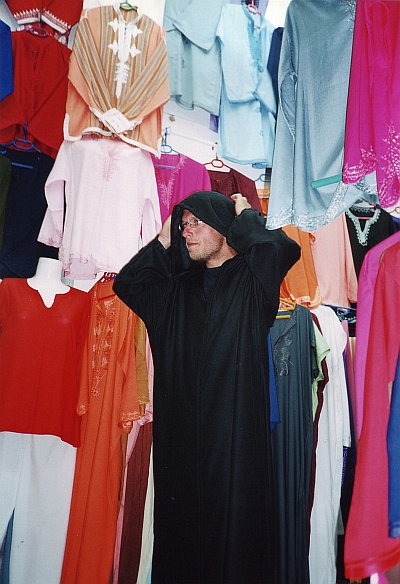
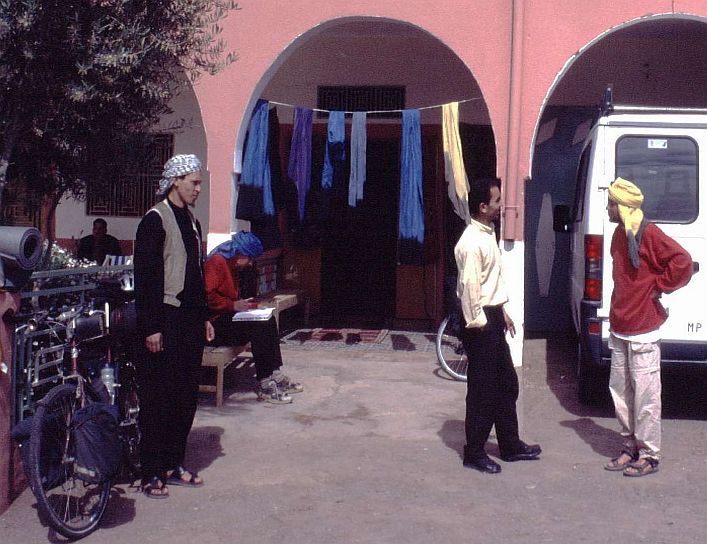
While Willem is resting in the morning, Marco and I spend the time in the souk of Rissani.
We more and more learn how the negotiating game must be played in Morocco. Do not buy
anything without leaving the store at least twice. Always remain friendly, patient
and resolute. When playing the rules, negotiating in Morocco is not as harsh at all
as it could seem in first instance.
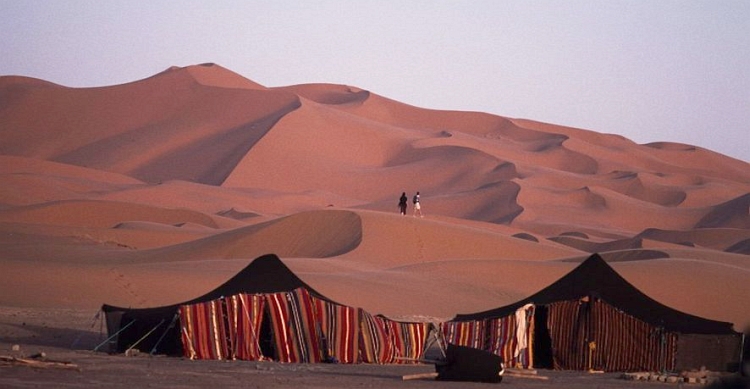
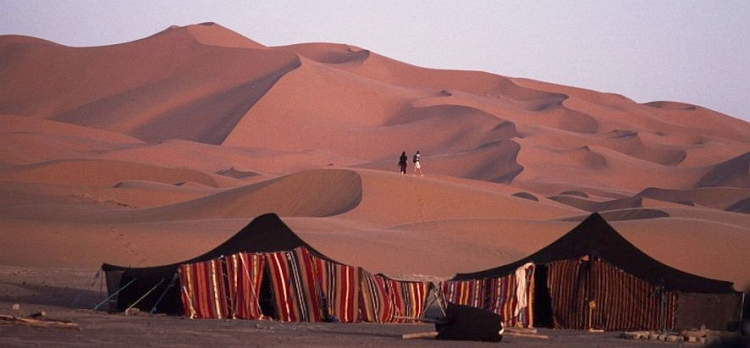
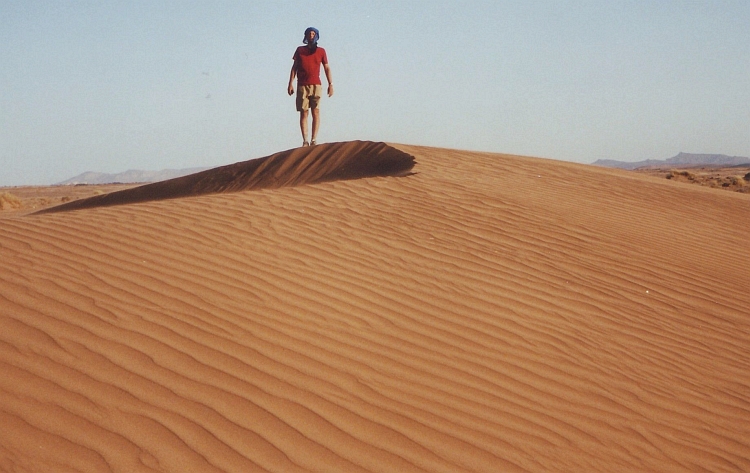
In the afternoon we leave for the last kilometres to our goal: the dunes of Merzouga,
the ultimate desert experience. When we leave, the temperature has already reached 43
degrees in the shadow. A bigger problem is the head wind that blows sand in the face
and in the eyes constantly. If the wind had blown a bit harder, it would have grown
to a desert storm.
Willem has not recovered as well as we hoped for. It is yet another very tough day for him
but he still wants to go on.
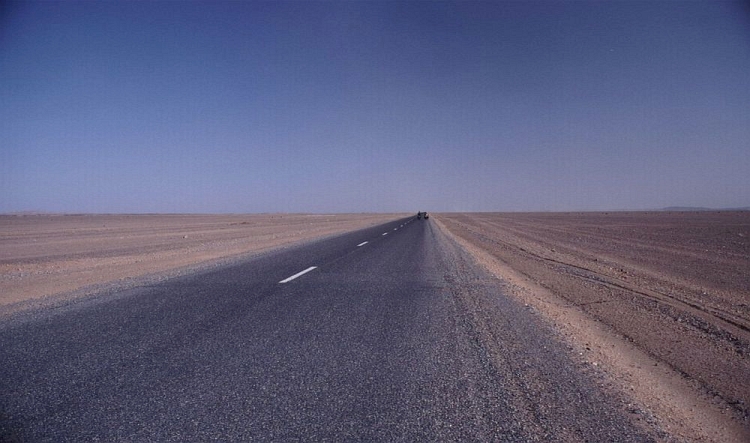
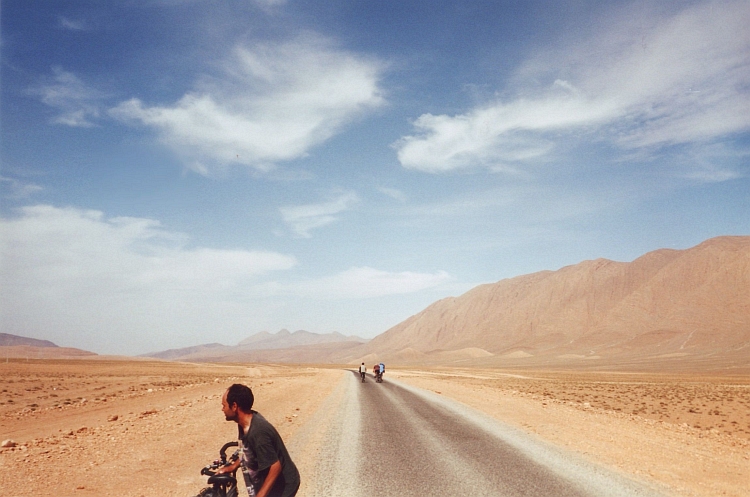
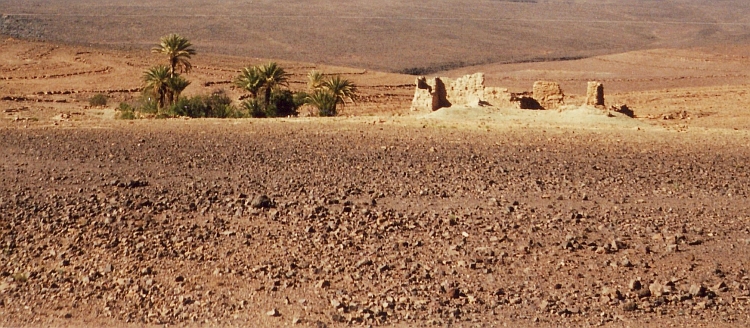
The landscape is completely flat. There is nothing at all, nothing but stones. And sand.
Although there is nothing to see, the emptiness has its own beauty. There is a quietness
coming over me despite the harsh circumstances. All the problems and possibilities
of life seem to dissolve in the infinity of the landscape.
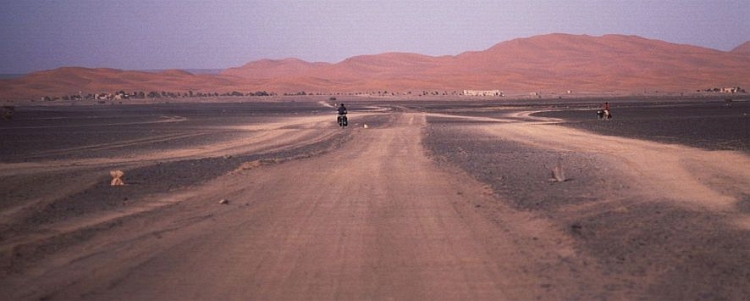
More than two hours we cycle against the wind through the empty landscape. Then we leave
the road for the trail that leads us to the dunes. In the distance we already see
them. We have a sidewind now, what makes life a bit easier. Rapidly we see
the dunes grow. We find a simple hotel on foot of the dunes. We have made it!
Day 11: Tinerhir - Imarirhen 15 km
We have three days to return to Marrakech. Because travelling by public transport
takes a bit more time here than in some other parts of the world, we will need
most of it. There is however time for one day of cycling. We choose to go
to Tinerhir tomorrow, just southward of the Atlas range. The day after tomorrow
we have one day to explore the Southern Atlas mountains in the surroundings of Tinerhir.
After cycling nearly a week through desert landscapes, the suroundings of Tinerhir
leave a green impression. It is three o'clock as we get out of the taxi and 4 o'clock
as we have finished packing our luggage. We have enough time to cycle a few
kilometres in the direction of the Gorges du Todra.
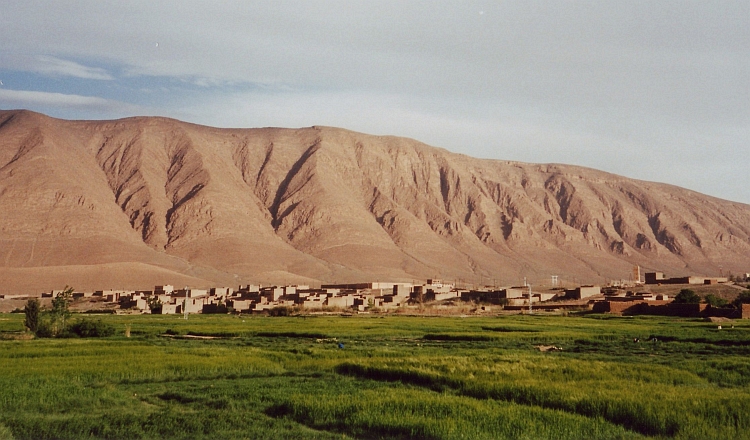
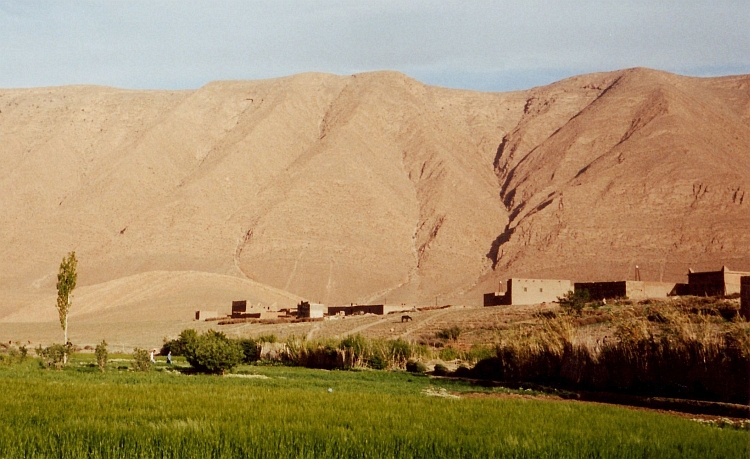
And so we do. The landscape is one of stark contrasts. The valleys are filled
with palm trees and flowers, the flanks of the mountains are devoid of vegetation.
After an hour we find a nice place to stay where the Todra valley is already narrow.
The gorges will not be too far tomorrow.
Day 12: Imarirhen - Toumliline - Imarirhen 90 km
Today is an easy day of cycling. Because we are riding a day trip we can do without
luggage. We are flying without the heavy luggage. Although we are climbing, we are able
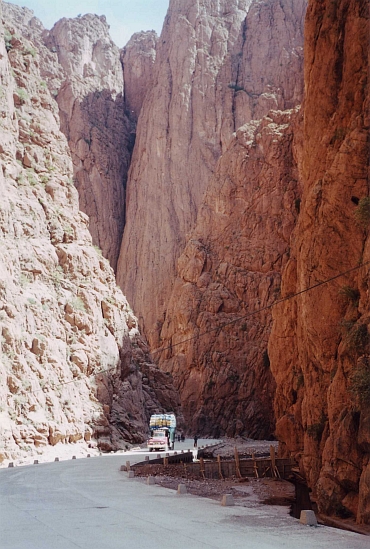
to ride in a good pace without getting tired. Soon we reach the Gorges du Todra. The
cliffs along the river are every bit as spectacular as we could have wished. As we ride
further upstream the valley, the landscape does not deteriorate. The valley is still
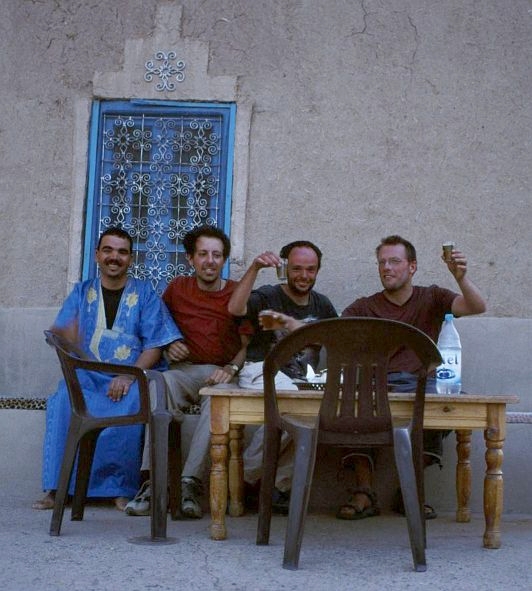
quite narrow. After a steeper stretch we find a tea stall. We sit down for another mint tea.
The owner offers us another tea and yet another tea. Different family members of the
owner come and sit down with us. One offers a free guide tour through the area. His nephew
will join us too.
The two have problems with their bicycles. After all they finally return. With two abominable old
mountainbikes. They still want to join us, so we say goodbye to the friendly owner. The
two start with a surprisingly good pace. After nearly two weeks of cycling I am glad I can
follow in the wheel of the uncle. One minute I am only looking at the rear wheel of
the uncle as his pace abruptly drops. Completely exhausted the tempo goes down from thirty
kilometres per hour to ten kilometres per hour. After a struggle of fifteen minutes
he says we have to stop for a tea. He has an uncle who can offer us free tea. Oh no,
not again another cup of tea!
The tea time takes more than half an hour. The tea is indeed free. After teatime
the nephew rides away with a gruesome velocity. We do not try to follow. We go on in an
ultrarelaxed pace. It is useless to go faster because our company will surely need
a long long rest. After a minute we see the nephew still cycling like crazy but now he
is only hundred meter ahead of us. A minute later he is hundred meter behind us. A minute
later we have to wait ten minutes untill the nephew is with us again. We proceed very
slowly for half an hour before we see another tea stall. We fear the worst. And yes,
the people have uncles everywhere. We have to stay for another tea.
After another twenty five minutes we can go on again. We climb higher and higher untill
we reach a village with loads of uncles. Because it is getting later and later we
accept tea from only one uncle. Despite promises that it will not take a long time, the
first uncle has finished the tea in thirty minutes. After drinking and chatting a little,
we simply must get back. We have only somewhat more than an hour of daylight for more
than forty kilometres. We are ride back as fast as we can. Unfortunately we cannot wait
for our company. We must go on whatsoever, we need to catch the early bus in Tinerhir tomorrow.
It is already dark as we reach the camping. Tomorrow we shall return. Tonight we will celebrate
the succesful journey with a good tajine and of course... tea!
Day 13: Tizi'n Tichka - Marrakech 110 km
The last day of the journey we cycle back to Marrakech.
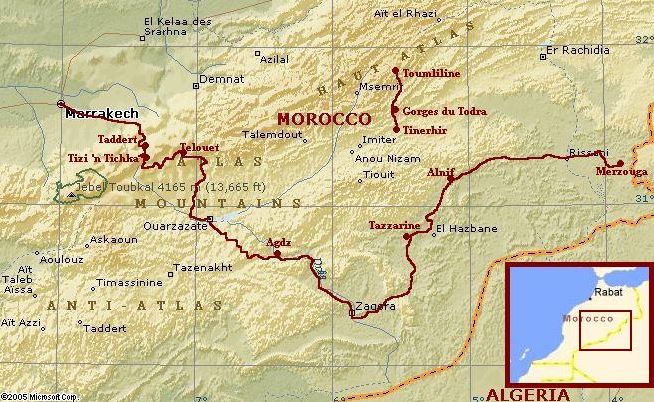
Map of the route
Statistics
Fast Facts
Fast Facts
# Days
# Cycling days
Distance on bicycle
Distance / Days
Longest distance on a day
Highest altitude difference on a day: climbing
Highest altitude difference on a day: descending
Highest point on bicycle
# children asking for a stylo
# stones in the landscape
# religious fanatics
Statistics
13
13
1.000 km
77 km
110 km
1.200 m (from Marrakech halfway Tizi'n Tichka)
1.800 m (from Tizi'n Tichka to Marrakech)
2.260 m (Tizi'n Tichka)
many
many
zero
Highlights of the Journey
Region
Marrakech
Atlas
Drâa Valley
Sahara
Sahara
Atlas
Highlights
Exploring the city of Marrakech with its souks, palm trees, African vibe and its sheer atmosphere
Passing through the fascinating and many coloured mountain landscape around Telouet
Visiting the desert town of Agdz and riding along the casbahs and oases of the Drâa Valley
Cycling the desolate and difficult desert track from Zagora to Tazzarine
Seeing the sun go down over the dunes of Merzouga
Cycling from Tinerhir through the dazzling Gorges du Todra up the wide valleys of the high Atlas
Day to Day
Day
1
2
3
4
5
6
7
8
9
10
11
12
13
Route
Marrakech - Taddert
Taddert - Telouet
Telouet - Aït Benhaddou
Aït Benhaddou - Ouarzazate - Agdz
Agdz - Zagora
Zagora - in the middle of nowhere
Campsite - Tazzarine
Tazzarine - Alnif
Alnif - Rissani
Rissani - Merzouga
Tinerhir - Imarirhen
Imarirhen - Toumliline - Imarirhen
Tizi'n Tichka - Marrakech
Km
85
65
70
90
90
55
45
65
90
40
15
90
110
Remarks
A long way up but not too steep, all paved
All paved to the pass, road to Telouet unpaved
Very bumpy road, lots of children asking for stylos!
Desert. Some large hill ranges to cross
Flat terrain along the river
Very difficult terrain, no water, tricky orientation.

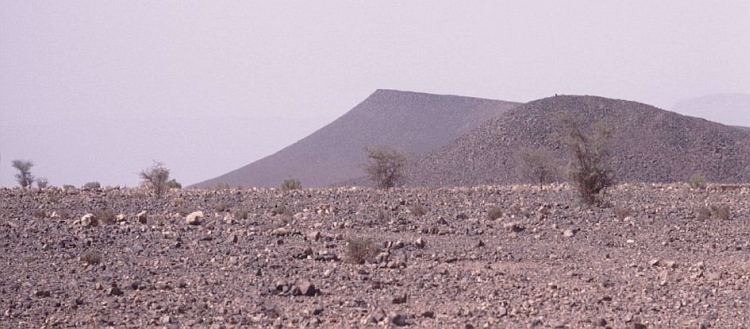
 We decide to go on. We surely need to find water though. After a few kilometres
I see a line of dust travelling across the road a few kilometres ahead of us. Is this
a fata morgana? It is not. It is a convoy of trucks. We are lucky; we
can ask for additional water. A few hundred meters before we meet the convoy, I
see the first cars take a different direction. A light panic is coming up. I cannot
accept the idea of missing our saviour by a hair. With all the force that is still in me
I ride towards the trucks. I am just in time for the last truck to see me. The truck
waits for me at the crossroads. I find out the chauffeur is Dutch. In Dutch I explain
our situation. A few beggars reach the place too (where the h### did they come from???)
The truck driver has got sufficient amounts of water and gives away enough for us and the beggars.
Instead of three liters for the last seventy kilometre we now have twelve liters each. The
other trucks have gathered on the crossroads too. It is a pleasant meeting of
likeminded souls. The Dutch truck drivers are also lucky. They were on their way
to Zagora. Without meeting us, they would have taken the wrong direction. If we
would not have met the convoy, we surely had to return the difficult road back to Zagora.
We decide to go on. We surely need to find water though. After a few kilometres
I see a line of dust travelling across the road a few kilometres ahead of us. Is this
a fata morgana? It is not. It is a convoy of trucks. We are lucky; we
can ask for additional water. A few hundred meters before we meet the convoy, I
see the first cars take a different direction. A light panic is coming up. I cannot
accept the idea of missing our saviour by a hair. With all the force that is still in me
I ride towards the trucks. I am just in time for the last truck to see me. The truck
waits for me at the crossroads. I find out the chauffeur is Dutch. In Dutch I explain
our situation. A few beggars reach the place too (where the h### did they come from???)
The truck driver has got sufficient amounts of water and gives away enough for us and the beggars.
Instead of three liters for the last seventy kilometre we now have twelve liters each. The
other trucks have gathered on the crossroads too. It is a pleasant meeting of
likeminded souls. The Dutch truck drivers are also lucky. They were on their way
to Zagora. Without meeting us, they would have taken the wrong direction. If we
would not have met the convoy, we surely had to return the difficult road back to Zagora.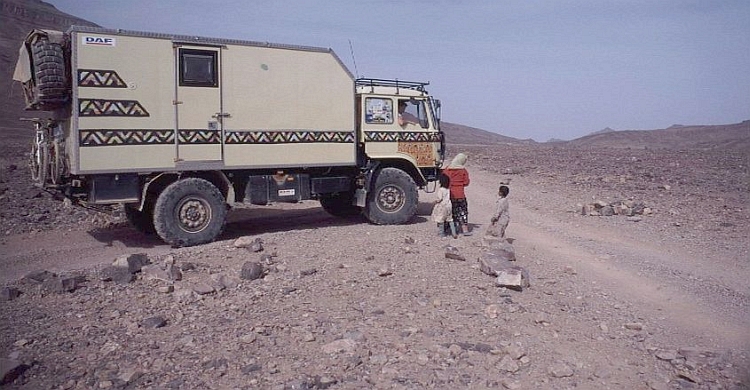
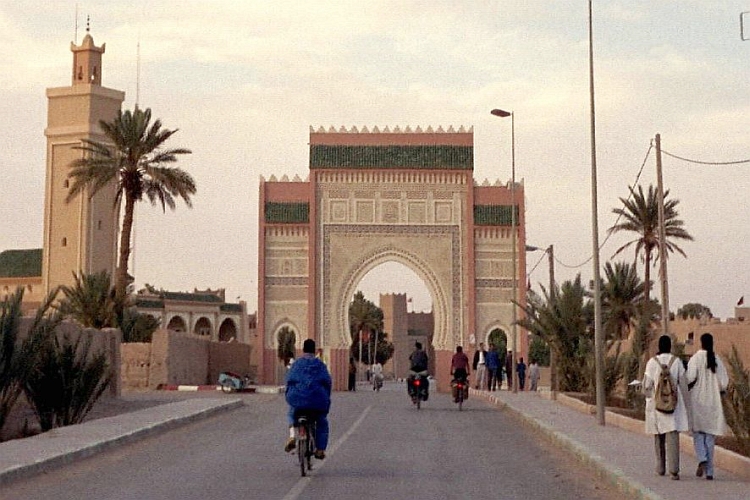
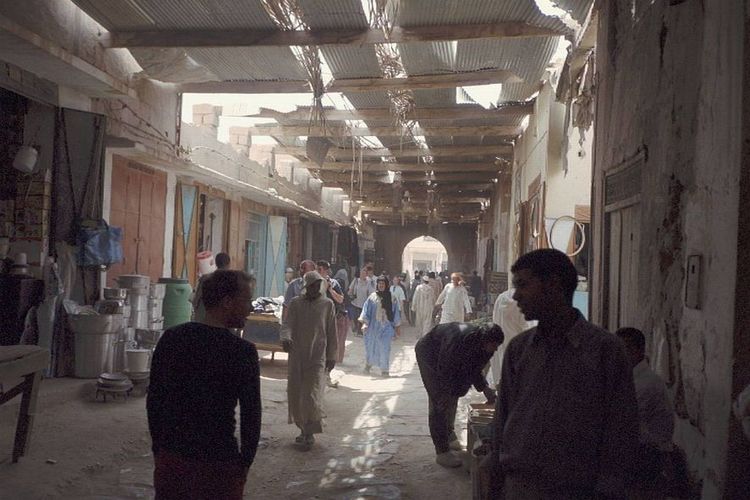
 While Willem is resting in the morning, Marco and I spend the time in the souk of Rissani.
We more and more learn how the negotiating game must be played in Morocco. Do not buy
anything without leaving the store at least twice. Always remain friendly, patient
and resolute. When playing the rules, negotiating in Morocco is not as harsh at all
as it could seem in first instance.
While Willem is resting in the morning, Marco and I spend the time in the souk of Rissani.
We more and more learn how the negotiating game must be played in Morocco. Do not buy
anything without leaving the store at least twice. Always remain friendly, patient
and resolute. When playing the rules, negotiating in Morocco is not as harsh at all
as it could seem in first instance.